Atlassino Academy · Blackjack · Lesson 1
Card values, soft and hard hands
The first thing a table asks you to know: what your cards add up to, and whether the ace among them can still be eleven.
You do not need to know anything about blackjack yet. How a round is played, who acts first and what the moves are all come later. Today you only count: what your cards add up to, and what the hand you are holding is called. Never sat at a table? The first-visit track shows you how.
You are dealt an ace and a six. What is the hand worth?
The short answer
An ace counts 1 or 11, whichever suits your hand. A jack, a queen and a king count ten; every other card counts the number printed on it. While an ace can still be eleven without taking the hand over 21, the hand is soft and has two totals at once; otherwise the hand is hard and has one total. A blackjack is 21 on your first two cards, an ace and a ten-value card. No other 21 is a blackjack: not a 21 of three cards, and not a 21 made after splitting aces or tens.
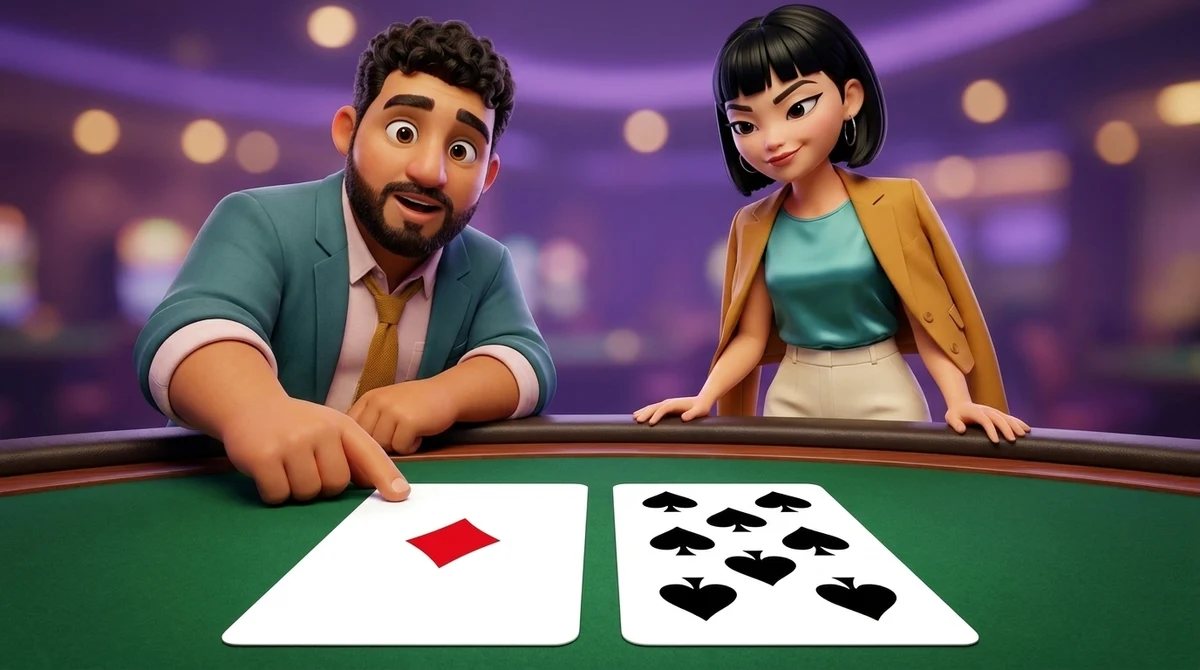

Leoformer dealer · rules and maths
I dealt this game before I taught it, and the quietest mistake at a table looks like this: the player makes the right move for a hand he is not holding. Every decision in blackjack is a decision about a number, so the number has to be the right one before anything else.
What each card is worth
You are trying to get close to 21 without ever going over it. The hand you play against is the dealer’s: a hand higher than the dealer’s is paid, a lower one loses, and a hand with the same points is a tie. The whole game sits in those two sentences, so the first skill to have is adding up the cards in your hand, quickly and without a mistake.
Cards 2 to 10 count the number printed on them
A jack, a queen and a king count ten, all three of them
The picture on the card is different; the value of the card is not.
An ace counts 1 or 11, whichever suits your hand
Cards come out of a shoe (the box the dealer deals from, holding several decks shuffled together) of 6 decks, and four of the thirteen kinds put ten on your hand: 30.8% of the cards in the shoe.
The ace: two numbers at once
The ace is the only card with two values: one or eleven, whichever suits your hand. The dealer’s ace follows a fixed rule instead: it counts eleven whenever eleven brings the dealer’s hand to 17 or more. An ace that can still be eleven without taking the hand over 21 gives the hand two totals at once; once eleven no longer fits, the ace is one and the hand has one total. The words for the two cases are soft and hard, and the test is one question, the eleven question:
- Step 1Count the ace as one and add the hand up.An ace and a six: 1 + 6 is 7.
- Step 2Add ten to that total.7 + 10 is 17.
- Step 3Is the new total 21 or under?Yes: the ace can be eleven, the hand has two totals, and the hand is soft. No: the ace is one, the hand has one total, and the hand is hard.
Soft
7 or 17An ace and a six. With the ace at eleven the hand is 17, inside 21: two totals.
Hard, no ace
17A ten and a seven. No card in the hand has two values: one total.
Hard, with an ace
17A ten and a six, then an ace. With the ace at eleven the hand would be 27: the ace is one, and the hand has one total.
About one starting hand in 7 has an ace in it, so you will be asking the eleven question often.
When a soft hand turns hard
Every new card asks the eleven question again.
Before the card
7 or 17A soft 17.
A three comes
10 or 20Still soft: 11 + 6 + 3 is 20, inside 21.
A ten comes
17Hard now: with the ace at eleven the hand would be 27, so the ace is one.
Two aces never both count eleven: 11 + 11 is already 22. However many aces a hand holds, at most one of them is eleven.
Blackjack, and what is not one
One hand at this table has a name of its own: the blackjack (twenty-one on your first two cards: the one hand a table pays at a rate of its own). A blackjack is 21 points on two cards: an ace and a ten-value card, as your first two cards.
A blackjack
Paid 3 to 2The ace counts eleven and the king counts ten: 21 on the first two cards.
21 on three cards
Paid 1 to 1Five, six and ten add up to 21, and three cards made it, so the hand is 21 and not a blackjack.
A blackjack is worth knowing on sight because of what it pays: any other hand that comes out higher than the dealer’s is paid 1 to 1, and a blackjack 3 to 2.
| Your hand | Paid at | Back, on an example bet of 10 units |
|---|---|---|
| Higher than the dealer’s hand | 1 to 1 | 10 units |
| A blackjack, when the dealer’s hand is not a blackjack | 3 to 2 | 15 units |
| The same points as the dealer’s hand; by our reading, a blackjack against a blackjack too | push (a tie: your bet comes back and nothing is paid) | nothing: your bet comes back |
| 21 on three cards or more, or 21 after splitting aces or tens | 1 to 1 | 10 units |
Twenty-one built from three cards or more pays the ordinary 1 to 1, and a blackjack always ranks above it, whichever side holds which: your blackjack ranks above the dealer’s 21 of three cards, and the dealer’s blackjack ranks above yours.
Twenty-one on a split hand. Split a pair of aces or a pair of ten-value cards, make 21 with the second card, and the hand is still not a blackjack: it is paid 1 to 1.
Two blackjacks. Every card is dealt face up, and the dealer has a single card while you play: the dealer’s second card comes only after every player has finished. So a blackjack in your hand waits for the dealer’s hand: the bets are settled once the dealer has made a total and announced it. The rules have no separate line for a blackjack against the dealer’s blackjack. They call a blackjack 21 points on two cards, make a hand with the same points as the dealer’s a tie, and name only a 21 of three cards or more as a hand a blackjack always stands above. Read together, two blackjacks are a tie, and your bet comes back.
What a misread costs
A misread is a move made for a hand you are not holding. Read a hard 17 with an ace in it as a soft 17, and you take a card on a hand that the chart stands on.
A hard 17 read as soft, against a 7
3.69 unitsa hand, on an example bet of 10 units: what taking another card costs against standing.
A hard 18 read as soft, against a 9
4.28 unitsa hand, on an example bet of 10 units, for the same mistake.
Amounts are for an example bet of 10 units; at twice the bet, twice the cost. Amounts are in betting units, not euros: a unit can stand for any amount, and the arithmetic is the same at any scale.
Even read correctly, every hand of the evening still costs: these rules leave the house 0.51% of every bet when every hand is played by the full chart. Reading the hand right keeps you from paying more than that.

Mayaformer floor supervisor · manners, money and breaks
Counting right is the first skill, and a limit set before you sit down is the second. If the money on the table starts to feel like money you need, stop and call one of the lines below.
If it stops being fun
If gambling stops being fun, the ANJ voluntary gambling ban applies in every casino in France. Minimum entry age: 18. Minors, even emancipated ones, may not enter a casino; ID is checked at the entrance to the gaming rooms. More on responsible gaming.
Show all regions
Practice table
Four levels: two cards, one more card, more than one ace, and the dealer waiting with the price of a misread. Every answer is the reading of the cards on the felt.
Lesson done
Review my mistakes (0)
Progress stays in this browser; nothing is sent anywhere.
The practice table needs JavaScript. Here is one hand from it, with the answer.
Level 2 · One more card
Blackjack · 6 decks, dealt from a shoe
You
A four and a two, then an ace. What do you hold?
The answer: A soft 17.
Count the ace as one first: 1 + 4 + 2 is 7. With the ace at eleven the hand is 17, still inside 21. Two totals, and the hand is soft.
Les As équivalent à 1 ou à 11 selon le jeu du joueurFree translation: Aces are worth 1 or 11 depending on the player's hand
Casinos Barrière · Blackjack — Mode d’emploi · readLorsqu'il a un as parmi ses cartes, il doit le compter pour 11 points si avec cette valeur il atteint 17 ou plus.Free translation: When he has an ace among his cards, he must count it as 11 points if with this value he reaches 17 or more.
Légifrance · Arrêté du 14 mai 2007 relatif à la réglementation des jeux dans les casinos · section Art. 35 (affichage), 55-4 (fonctionnement du black-jack), 55-5 (maxima et minima) · readLevel 1 · Two cards
Blackjack · 6 decks, dealt from a shoe
You
An ace and a six. What do you hold?
The answer: A soft 17.
The ace counts one or eleven, whichever suits the hand. 1 + 6 is 7, and with the ace at eleven 17, still inside 21. Two totals at once, and the hand is soft.
Les As équivalent à 1 ou à 11 selon le jeu du joueurFree translation: Aces are worth 1 or 11 depending on the player's hand
Casinos Barrière · Blackjack — Mode d’emploi · readLorsqu'il a un as parmi ses cartes, il doit le compter pour 11 points si avec cette valeur il atteint 17 ou plus.Free translation: When he has an ace among his cards, he must count it as 11 points if with this value he reaches 17 or more.
Légifrance · Arrêté du 14 mai 2007 relatif à la réglementation des jeux dans les casinos · section Art. 35 (affichage), 55-4 (fonctionnement du black-jack), 55-5 (maxima et minima) · readEvery hand is read the same way: add the cards, then ask whether an ace among them can still be eleven.
Check yourself

Mayaformer floor supervisor · manners, money and breaks
Five quick ones. Pick an answer, then check it. No timer, no points: just whether it stuck.
And the question we opened with
An ace and a six: a soft 17, worth 7 or 17. The ace stays free to be eleven until a card takes the eleven away.
Where to play, and further reading
18+ across France · Play responsibly · the helplines are further up this page
Further reading
- Arrêté du 14 mai 2007, art. 55-4 et 55-5 (black-jack) · Ministère de l’Intérieur (Légifrance)The national blackjack rules for every casino in France: six decks, no hole card, the dealer stands on all 17s, 3 to 2, and the options a casino may set in its house rules.
How it’s worked out
Rules, numbers and hosts
Soft and hard. The two words are the trade’s words, and the definition on this page is ours: a hand is soft while an ace in it can count eleven without the hand going over 21, and hard otherwise. The Arrêté and the operator’s guide we read give the card values and the ace’s two values and define no soft or hard hand; the practice table reads every hand by this definition.
Rules. The decks, the 3 to 2 and the figures follow the national rules for blackjack in every casino in France, the Arrêté of 14 May 2007: six decks, blackjack paid 3 to 2, the dealer standing on every 17 and counting an ace as eleven whenever that makes 17 or more, and every card dealt face up, with the dealer’s second card dealt after the players. A casino may set options of its own in its house rules — surrender for half the bet except against an ace, no card on 21, limits on splitting, no double after a split; the figures leave them out. Two blackjacks are a tie by our reading of the rules on equal points, not by a line of their own. What a dealer blackjack takes from a double or a split the rules do not say; the house edge assumes the costlier reading, that it takes every bet on the hand. It is a preset for learning, not a statement about any one casino.
Numbers. The share of ten-value cards is card arithmetic on the shoe. A misread’s cost is worked out by our blackjack engine: the average result of the chart’s move minus that of the move made for the wrong hand, for an example bet of 10 units, each average rounded to the hundredth first. The house edge assumes the full chart and cards shuffled after every hand.
Hosts. Leo and Maya are illustrated characters. Their backstories, a former dealer and a former floor supervisor, are written for the course: neither is a real person, and neither speaks for any casino. The rules and numbers on this page come from the sources it cites, not from their experience.
No promise. Blackjack is played against the house. Reading your hand correctly keeps you from paying more than the game already costs; nothing on this page removes that cost or says how an evening will end.
An ace counts two ways
Les As équivalent à 1 ou à 11 selon le jeu du joueurFree translation: Aces are worth 1 or 11 depending on the player's hand
Lorsqu'il a un as parmi ses cartes, il doit le compter pour 11 points si avec cette valeur il atteint 17 ou plus.Free translation: When he has an ace among his cards, he must count it as 11 points if with this value he reaches 17 or more.
Section Art. 35 (affichage), 55-4 (fonctionnement du black-jack), 55-5 (maxima et minima)
Légifrance · Arrêté du 14 mai 2007 relatif à la réglementation des jeux dans les casinos · read
Two blackjacks: the lines the answer is read from
Le croupier, après avoir déterminé et annoncé un point, procède au ramassage des mises perdantes et au paiement des mises gagnantes dans l'ordre prévu, de droite à gauche.Free translation: The dealer, after determining and announcing a point total, collects the losing bets and pays the winning bets in the prescribed order, from right to left.
Les mains qui ont obtenu un point égal à celui du croupier sont nulles.Free translation: Hands that have obtained a point total equal to the dealer's are tied.
si un joueur fait un "black-jack", c'est-à-dire 21 points avec deux cartes, il est payé à raison de 3 pour 2.Free translation: if a player gets a "blackjack", that is to say 21 points with two cards, he is paid at 3 for 2.
Le "black-jack" l'emporte toujours sur 21 points obtenus avec plus de deux cartes.Free translation: The "blackjack" always beats 21 points obtained with more than two cards.
Section Art. 35 (affichage), 55-4 (fonctionnement du black-jack), 55-5 (maxima et minima)
Légifrance · Arrêté du 14 mai 2007 relatif à la réglementation des jeux dans les casinos · read
What a blackjack is
si un joueur fait un "black-jack", c'est-à-dire 21 points avec deux cartes, il est payé à raison de 3 pour 2.Free translation: if a player gets a "blackjack", that is to say 21 points with two cards, he is paid at 3 for 2.
Section Art. 35 (affichage), 55-4 (fonctionnement du black-jack), 55-5 (maxima et minima)
Légifrance · Arrêté du 14 mai 2007 relatif à la réglementation des jeux dans les casinos · read
est composée d’un As et d’une carte valant 10, pour un total de 21, reçues dès le début.Free translation: is made up of an Ace and a card worth 10, for a total of 21, received at the very start.
The object of the game
Rapprochez-vous du 21 sans jamais le dépasserFree translation: Get close to 21 without ever going over it
How the bets are settled
Si le croupier a plus de 21 points, il paie toutes les mises encore sur le tapis, s'il n'a pas atteint 21, il ramasse les mises des mains qui ont un point inférieur au sien et paie celles qui ont un point supérieur au sien.Free translation: If the dealer has more than 21 points, he pays all the bets still on the layout; if he has not reached 21, he collects the bets of the hands that have a lower point total than his and pays those that have a higher point total than his.
Les mains qui ont obtenu un point égal à celui du croupier sont nulles.Free translation: Hands that have obtained a point total equal to the dealer's are tied.
Section Art. 35 (affichage), 55-4 (fonctionnement du black-jack), 55-5 (maxima et minima)
Légifrance · Arrêté du 14 mai 2007 relatif à la réglementation des jeux dans les casinos · read
Card values
chaque carte a sa propre valeur nominale.Free translation: each card has its own face value.
Les 10, Valets, Dames et Rois valent 10Free translation: 10s, Jacks, Queens and Kings are worth 10
Les As équivalent à 1 ou à 11 selon le jeu du joueurFree translation: Aces are worth 1 or 11 depending on the player's hand
Six decks in France
Le jeu du black-jack se joue avec six jeux de cinquante-deux cartes, trois d'une couleur et trois de l'autre.Free translation: The game of blackjack is played with six decks of fifty-two cards, three of one colour and three of the other.
Section Art. 55-4, Fonctionnement du black-jack
An ace counts two ways
Les As équivalent à 1 ou à 11 selon le jeu du joueurFree translation: Aces are worth 1 or 11 depending on the player's hand
Lorsqu'il a un as parmi ses cartes, il doit le compter pour 11 points si avec cette valeur il atteint 17 ou plus.Free translation: When he has an ace among his cards, he must count it as 11 points if with this value he reaches 17 or more.
Section Art. 35 (affichage), 55-4 (fonctionnement du black-jack), 55-5 (maxima et minima)
Légifrance · Arrêté du 14 mai 2007 relatif à la réglementation des jeux dans les casinos · read
What a blackjack is
si un joueur fait un "black-jack", c'est-à-dire 21 points avec deux cartes, il est payé à raison de 3 pour 2.Free translation: if a player gets a "blackjack", that is to say 21 points with two cards, he is paid at 3 for 2.
Section Art. 35 (affichage), 55-4 (fonctionnement du black-jack), 55-5 (maxima et minima)
Légifrance · Arrêté du 14 mai 2007 relatif à la réglementation des jeux dans les casinos · read
est composée d’un As et d’une carte valant 10, pour un total de 21, reçues dès le début.Free translation: is made up of an Ace and a card worth 10, for a total of 21, received at the very start.
What a hand is paid
Les paiements se font à égalitéFree translation: Payouts are made at even money
Section Art. 35 (affichage), 55-4 (fonctionnement du black-jack), 55-5 (maxima et minima)
Légifrance · Arrêté du 14 mai 2007 relatif à la réglementation des jeux dans les casinos · read
A two-card 21 and a 21 built from more cards
Le "black-jack" l'emporte toujours sur 21 points obtenus avec plus de deux cartes.Free translation: The "blackjack" always beats 21 points obtained with more than two cards.
Section Art. 35 (affichage), 55-4 (fonctionnement du black-jack), 55-5 (maxima et minima)
Légifrance · Arrêté du 14 mai 2007 relatif à la réglementation des jeux dans les casinos · read
Twenty-one after a split
Si un joueur partage une paire d'as ou une paire de cartes valant 10 points et s'il totalise 21 points avec la deuxième carte tirée, ce point n'est pas considéré comme un "black-jack" et n'est payé qu'à égalité.Free translation: If a player splits a pair of aces or a pair of cards worth 10 points and totals 21 points with the second card drawn, this total is not considered a "blackjack" and is paid only at even money.
Section Art. 35 (affichage), 55-4 (fonctionnement du black-jack), 55-5 (maxima et minima)
Légifrance · Arrêté du 14 mai 2007 relatif à la réglementation des jeux dans les casinos · read
The deal in France
A l'issue de ce tour, il se donne une carte, puis distribue une seconde carte, toujours dans le même ordre, à chaque main.Free translation: At the end of this round, he deals himself a card, then deals a second card, always in the same order, to each hand.
Les cartes sont, dans tous les cas, distribuées figure en dessus.Free translation: The cards are, in all cases, dealt face up.
Lorsque tous les joueurs ont déterminé la situation de leurs mains, le croupier tire une ou plusieurs cartes pour lui-même.Free translation: When all the players have determined the status of their hands, the dealer draws one or more cards for himself.
Section Art. 55-4, 1° Jeu simple et black-jack
Two blackjacks: the lines the answer is read from
Le croupier, après avoir déterminé et annoncé un point, procède au ramassage des mises perdantes et au paiement des mises gagnantes dans l'ordre prévu, de droite à gauche.Free translation: The dealer, after determining and announcing a point total, collects the losing bets and pays the winning bets in the prescribed order, from right to left.
Les mains qui ont obtenu un point égal à celui du croupier sont nulles.Free translation: Hands that have obtained a point total equal to the dealer's are tied.
si un joueur fait un "black-jack", c'est-à-dire 21 points avec deux cartes, il est payé à raison de 3 pour 2.Free translation: if a player gets a "blackjack", that is to say 21 points with two cards, he is paid at 3 for 2.
Le "black-jack" l'emporte toujours sur 21 points obtenus avec plus de deux cartes.Free translation: The "blackjack" always beats 21 points obtained with more than two cards.
Section Art. 35 (affichage), 55-4 (fonctionnement du black-jack), 55-5 (maxima et minima)
Légifrance · Arrêté du 14 mai 2007 relatif à la réglementation des jeux dans les casinos · read
What a casino may set in its house rules
La direction du casino peut, dans son règlement intérieur :Free translation: The casino management may, in its house rules:
autoriser un joueur à abandonner la partie, après distribution de ses deux premières cartes et sous réserve que le croupier n'ait pas d'as, ce qui entraînera la perte de la moitié de sa miseFree translation: allow a player to give up the hand, after his first two cards have been dealt and provided that the dealer does not have an ace, which will result in the loss of half of his bet
interdire à tout joueur de tirer une nouvelle carte à 21Free translation: prohibit any player from drawing another card on 21
La direction du casino a la possibilité, dans son règlement intérieur affiché, de limiter les paires aux cartes similaires, excluant ainsi les cartes différentes mais de valeur identique. Elle peut également limiter le nombre des paires que peut constituer un même joueur.Free translation: The casino management may, in its posted house rules, limit pairs to similar cards, thereby excluding different cards of identical value. It may also limit the number of pairs that a single player can form.
Toutefois, la direction du casino peut, dans son règlement intérieur, en exclure la possibilité en ce qui concerne les paires.Free translation: However, the casino management may, in its house rules, exclude this possibility as regards pairs.
Section Art. 35 (affichage), 55-4 (fonctionnement du black-jack), 55-5 (maxima et minima)
Légifrance · Arrêté du 14 mai 2007 relatif à la réglementation des jeux dans les casinos · read