An ace and a 6 against a 10, kept
2.08 unitseach time you stand on a soft 17 against a 10 instead of taking a card. Against a 2, 1.51 units.
Fix: soft 17 or less, never stand.
Atlassino Academy · Blackjack · Lesson 8
The hands where an ace still counts as 11, and what to do with them when the rules let you double on any two cards.
A soft hand is a hand where an ace counts 11 and can still drop to 1. The ace counts one or eleven, whichever suits the hand, so one card cannot take a soft hand over 21: at worst the ace steps down.
You are dealt an ace and a 7: soft 18. The dealer shows a 6. Do you stand on 18, take a card, or double?
Soft 13 to 17: double against the dealer’s middle cards — a 5 or 6 for soft 13 and 14, a 4 to 6 for soft 15 and 16, a 3 to 6 for soft 17 — and take a card against everything else. Soft 18: double against a 3 to 6, stand against a 2, 7 or 8, take a card against a 9, a 10 or an ace. Soft 19 and 20: stand. A double is allowed on your first two cards only: on a soft hand of three cards, where the chart would double, stand on soft 18 and take a card on soft 17 or less.
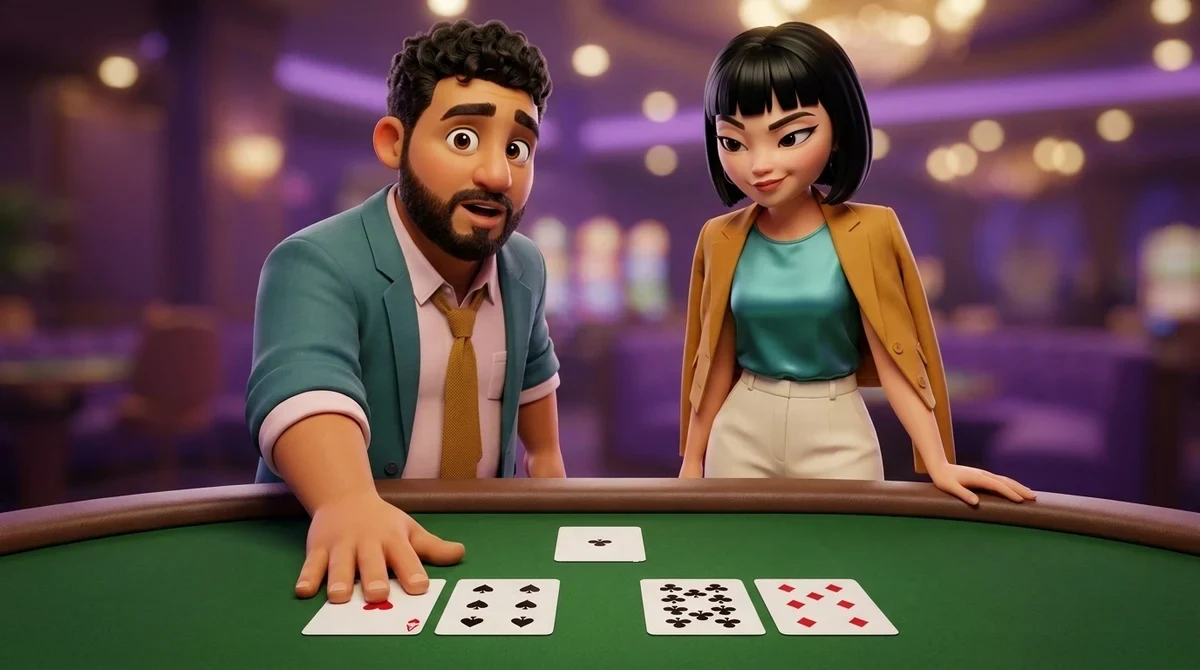

Leoformer dealer · rules and maths
A soft hand is the one hand at the table you can draw to without fear of going over. The chart uses that twice: it keeps drawing to every soft total up to 17, and against the dealer’s weakest cards it puts a second bet on the one card that cannot break you.
Put a 10 on a hard 17 and the hand is over 21. Put the same 10 on a soft 17 and the ace simply drops to 1: the hand becomes a hard 17 and is still in play. The table below shows every card you could take.
| Your hand | The card you take | |||||||||
|---|---|---|---|---|---|---|---|---|---|---|
| A | 2 | 3 | 4 | 5 | 6 | 7 | 8 | 9 | 10 | |
| A hard 17 — a 10 and a 7 | 18 | 19 | 20 | 21 | 22 — over 21, hand lost | 23 — over 21, hand lost | 24 — over 21, hand lost | 25 — over 21, hand lost | 26 — over 21, hand lost | 27 — over 21, hand lost |
| A soft 17 — an ace and a 6 | 18 | 19 | 20 | 21 | 12 | 13 | 14 | 15 | 16 | 17 |
Each cell is where the hand lands after one card of that value; the jack, queen and king land where the 10 does. The hard 17 goes over 21 on every card from a 5 up; the soft 17 never does. A soft 17 tops out at 21 with one card.
Six decks · the dealer stands on every 17 · double on any first two cards · house edge 0.51% with the full chart
| Soft | 2 | 3 | 4 | 5 | 6 | 7 | 8 | 9 | 10 | A |
|---|---|---|---|---|---|---|---|---|---|---|
| A,2 | H | H | H | Dh | Dh | H | H | H | H | H |
| A,3 | H | H | H | Dh | Dh | H | H | H | H | H |
| A,4 | H | H | Dh | Dh | Dh | H | H | H | H | H |
| A,5 | H | H | Dh | Dh | Dh | H | H | H | H | H |
| A,6 | H | Dh | Dh | Dh | Dh | H | H | H | H | H |
| A,7 | S | Ds | Ds | Ds | Ds | S | S | H | H | H |
| A,8 | S | S | S | S | S | S | S | S | S | S |
| A,9 | S | S | S | S | S | S | S | S | S | S |
Soft 13 to 17: double or take a card. Each row doubles against a few of the dealer’s middle cards, and the higher the soft total, the more cards it doubles against: soft 13 and 14 against a 5 or 6, soft 15 and 16 against a 4 to 6, soft 17 against a 3 to 6. Against every other card, take a card.
Soft 18: three answers. Double against a 3 to 6, stand against a 2, 7 or 8, take a card against a 9, a 10 or an ace.
Soft 19 and 20: stand, against every dealer card.
Here is the same chart, row by row, in words:
Whatever your first two cards add up to, you may double: put out a second bet equal to the first, and take exactly one more card. A soft hand is a good hand to do it on, because the one card you get cannot take it over 21. The chart does it only against a 3 to 6, the four dealer cards from which the dealer goes over 21 most often.
| Dealer shows | Stand on 17 | Take a card | Double | The chart says |
|---|---|---|---|---|
| a 2 | −1.50 units | +0.01 units | −0.04 units | Take a card |
| a 6 | +0.12 units | +1.29 units | +2.59 units | Double |
| a 10 | −4.63 units | −2.55 units | −5.70 units | Take a card |
Amounts are averages per hand for an example bet of 10 units, an example and not a suggested bet. Amounts are in betting units, not euros: a unit can stand for any amount, and the arithmetic is the same at any scale. The double puts twice the money on the felt, and the averages above are for the whole of it.
Two letters in a cell mean two answers. Dh: double, and if you cannot double, take a card. Ds: double, and if you cannot double, stand. You cannot double a hand of three cards, so the second letter is the answer there.
Eighteen feels like a hand to keep, and against a 2, a 7 or an 8 it is. Against a 3 to 6 the chart doubles it: the one card cannot break it, and the dealer’s card is weak. Against a 9, a 10 or an ace the chart takes a card, because the dealer finishes above 18 often enough that a card which cannot take a soft 18 over 21 does better on average than standing.
| Dealer shows | Stand on 18 | Take a card | Double | The chart says |
|---|---|---|---|---|
| a 2 | +1.24 units | +0.63 units | +1.21 units | Stand |
| a 6 | +2.80 units | +1.91 units | +3.83 units | Double |
| an 8 | +1.08 units | +0.41 units | −0.28 units | Stand |
| a 9 | −1.83 units | −0.98 units | −2.85 units | Take a card |
| a 10 | −2.41 units | −2.07 units | −4.66 units | Take a card |
| an ace | −3.80 units | −3.76 units | −8.71 units | Take a card |
Amounts are averages per hand for an example bet of 10 units, an example and not a suggested bet. A plus sign is an average over many hands; any one hand can still lose.
An ace you draw later counts the same way: 11 while that keeps the hand at 21 or under, and 1 after that. A 2, a 5 and an ace is a soft 18 like an ace and a 7, and it reads off the same row of the chart. What changes is the double: it is allowed on your first two cards only, so a soft hand of three cards takes the second letter of its cell — stand on soft 18 where the cell reads Ds, take a card on soft 17 or less where it reads Dh. The moment a card would take the ace past 21, the hand turns hard, and the hard-totals chart answers it from there.
No amounts are shown for hands of three cards: our figures are worked out for two-card hands.
Amounts are for an example bet of 10 units; at twice the bet, twice the cost.
each time you stand on a soft 17 against a 10 instead of taking a card. Against a 2, 1.51 units.
Fix: soft 17 or less, never stand.
each time you only take a card on a soft 17 against a 6 instead of doubling. Standing costs 2.47 units.
Fix: soft 17 against a 3 to 6, double.
each time you stand on a soft 18 against a 9. Against a 10, 0.34 units.
Fix: soft 18 against a 9, a 10 or an ace, take a card.
The house keeps its edge; the chart only makes it smaller. Play every cell of the chart and these rules still leave the house 0.51% of every bet.

Mayaformer floor supervisor · manners, money and breaks
A double is the chart asking for a second bet on one card. Before you put it down, check that the second bet fits the money you set aside for the evening; if it does not, play the second letter of the cell instead, and that is fine. Decide your time and your money before you sit down, and keep to them. If the money starts to feel like money you need, stop and call one of the lines below.
If gambling stops being fun, the ANJ voluntary gambling ban applies in every casino in France. Minimum entry age: 18. Minors, even emancipated ones, may not enter a casino; ID is checked at the entrance to the gaming rooms. More on responsible gaming.
Two levels: first a soft hand on the two cards you are dealt, where you may stand, take a card or double; then a soft hand of three cards with the ace drawn third, where the double is gone and the second letter of the cell answers. Every answer is a cell of the chart for these rules, read from the engine. Amounts are for an example bet of 10 units, an example and not a suggested bet; hands of three cards carry no amount.
Progress stays in this browser; nothing is sent anywhere.
The practice table needs JavaScript. Here is one hand from it, with the answer.
Dealer shows a 6
You
Your hand an ace and a 2
You are dealt an ace and a 2: soft 13. The dealer shows a 6. What does the chart say?
The cell for a soft 13 against a 6 reads Dh: double, and take a card if you cannot double. These are your first two cards, so the double is allowed, and the chart doubles.
One strip, no rounds. Every square on the strip is one hand of this lesson, and they are all there from the start. The square keeps your first answer; when a level’s squares are full the next level begins by itself.
Levels. Level 1: an ace and a 2 to 8 as your first two cards, against the dealer’s card: stand, take a card or double. Level 2: soft hands of three cards, with the ace as the third card, where a double is no longer allowed.

Mayaformer floor supervisor · manners, money and breaks
Five quick ones. Pick an answer, then check it. No timer, no points: just whether it stuck.
An ace and a 7 against a 6: double. Standing averages +2.80 units a hand on an example bet of 10 units, taking a card +1.91 units, doubling +3.83 units — counted on both bets together.
18+ across France · Play responsibly · the helplines are further up this page
Rules. The figures on this page follow the national rules for blackjack in every casino in France: six decks, the dealer standing on every 17 and counting an ace as 11 whenever that makes 17 or more, a double on any first two cards and after a split, and every card dealt face up, with the dealer’s second card dealt after the players. A casino may set options of its own in its house rules — surrender for half the bet except against an ace, no card on 21, no double after a split; the figures leave them out. What a dealer blackjack takes from a double or a split the rules do not say; the house edge assumes it takes every bet on the hand. It is a preset for learning, not a statement about any one casino.
Numbers. Every figure is worked out when the page is built, by our blackjack engine. An average for a double counts both bets. A cost is the difference of two averages for an example bet of 10 units, each rounded to the hundredth first. The landing totals are card arithmetic. The averages are worked out for two-card hands, so hands of three cards carry no amount.
Hosts. Leo and Maya are illustrated characters. Their backstories, a former dealer and a former floor supervisor, are written for the course: neither is a real person, and neither speaks for any casino. The rules and numbers on this page come from the sources it cites, not from their experience.
No promise. Blackjack is played against the house. The chart lowers the price of playing; nothing on this page removes that price or tells you how an evening will end.
An ace counts two ways
Les As équivalent à 1 ou à 11 selon le jeu du joueurFree translation: Aces are worth 1 or 11 depending on the player's hand
Lorsqu'il a un as parmi ses cartes, il doit le compter pour 11 points si avec cette valeur il atteint 17 ou plus.Free translation: When he has an ace among his cards, he must count it as 11 points if with this value he reaches 17 or more.
Section Art. 35 (affichage), 55-4 (fonctionnement du black-jack), 55-5 (maxima et minima)
Légifrance · Arrêté du 14 mai 2007 relatif à la réglementation des jeux dans les casinos · read
Doubling in France
Quel que soit le nombre de points obtenu avec ses deux premières cartes, il peut doubler sa mise.Free translation: Whatever the number of points obtained with his first two cards, he may double his bet.
Section Art. 35 (affichage), 55-4 (fonctionnement du black-jack), 55-5 (maxima et minima)
Légifrance · Arrêté du 14 mai 2007 relatif à la réglementation des jeux dans les casinos · read
Dans ce cas, il n'a droit qu'à une seule carte supplémentaire.Free translation: In this case, he is entitled to only one additional card.
Section Art. 35 (affichage), 55-4 (fonctionnement du black-jack), 55-5 (maxima et minima)
Légifrance · Arrêté du 14 mai 2007 relatif à la réglementation des jeux dans les casinos · read
The double in France
Quel que soit le nombre de points obtenu avec ses deux premières cartes, il peut doubler sa mise. Dans ce cas, il n'a droit qu'à une seule carte supplémentaire.Free translation: Whatever the number of points obtained with his first two cards, he may double his bet. In this case, he is entitled to only one additional card.
Section Art. 55-4, 4° La double mise
An ace counts two ways
Les As équivalent à 1 ou à 11 selon le jeu du joueurFree translation: Aces are worth 1 or 11 depending on the player's hand
Lorsqu'il a un as parmi ses cartes, il doit le compter pour 11 points si avec cette valeur il atteint 17 ou plus.Free translation: When he has an ace among his cards, he must count it as 11 points if with this value he reaches 17 or more.
Section Art. 35 (affichage), 55-4 (fonctionnement du black-jack), 55-5 (maxima et minima)
Légifrance · Arrêté du 14 mai 2007 relatif à la réglementation des jeux dans les casinos · read
The deal in France
A l'issue de ce tour, il se donne une carte, puis distribue une seconde carte, toujours dans le même ordre, à chaque main.Free translation: At the end of this round, he deals himself a card, then deals a second card, always in the same order, to each hand.
Les cartes sont, dans tous les cas, distribuées figure en dessus.Free translation: The cards are, in all cases, dealt face up.
Lorsque tous les joueurs ont déterminé la situation de leurs mains, le croupier tire une ou plusieurs cartes pour lui-même.Free translation: When all the players have determined the status of their hands, the dealer draws one or more cards for himself.
Section Art. 55-4, 1° Jeu simple et black-jack
Doubling in France
Quel que soit le nombre de points obtenu avec ses deux premières cartes, il peut doubler sa mise.Free translation: Whatever the number of points obtained with his first two cards, he may double his bet.
Section Art. 35 (affichage), 55-4 (fonctionnement du black-jack), 55-5 (maxima et minima)
Légifrance · Arrêté du 14 mai 2007 relatif à la réglementation des jeux dans les casinos · read
Dans ce cas, il n'a droit qu'à une seule carte supplémentaire.Free translation: In this case, he is entitled to only one additional card.
Section Art. 35 (affichage), 55-4 (fonctionnement du black-jack), 55-5 (maxima et minima)
Légifrance · Arrêté du 14 mai 2007 relatif à la réglementation des jeux dans les casinos · read
The dealer stands on a soft 17
S'il a 17 points ou plus, il est obligé de rester, il ne peut prendre de cartes supplémentairesFree translation: If he has 17 points or more, he is obliged to stand, he cannot take additional cards
Lorsqu'il a un as parmi ses cartes, il doit le compter pour 11 points si avec cette valeur il atteint 17 ou plus.Free translation: When he has an ace among his cards, he must count it as 11 points if with this value he reaches 17 or more.
Section Art. 35 (affichage), 55-4 (fonctionnement du black-jack), 55-5 (maxima et minima)
Légifrance · Arrêté du 14 mai 2007 relatif à la réglementation des jeux dans les casinos · read
What a casino may set in its house rules
La direction du casino peut, dans son règlement intérieur :Free translation: The casino management may, in its house rules:
autoriser un joueur à abandonner la partie, après distribution de ses deux premières cartes et sous réserve que le croupier n'ait pas d'as, ce qui entraînera la perte de la moitié de sa miseFree translation: allow a player to give up the hand, after his first two cards have been dealt and provided that the dealer does not have an ace, which will result in the loss of half of his bet
interdire à tout joueur de tirer une nouvelle carte à 21Free translation: prohibit any player from drawing another card on 21
La direction du casino a la possibilité, dans son règlement intérieur affiché, de limiter les paires aux cartes similaires, excluant ainsi les cartes différentes mais de valeur identique. Elle peut également limiter le nombre des paires que peut constituer un même joueur.Free translation: The casino management may, in its posted house rules, limit pairs to similar cards, thereby excluding different cards of identical value. It may also limit the number of pairs that a single player can form.
Toutefois, la direction du casino peut, dans son règlement intérieur, en exclure la possibilité en ce qui concerne les paires.Free translation: However, the casino management may, in its house rules, exclude this possibility as regards pairs.
Section Art. 35 (affichage), 55-4 (fonctionnement du black-jack), 55-5 (maxima et minima)
Légifrance · Arrêté du 14 mai 2007 relatif à la réglementation des jeux dans les casinos · read