Atlassino Academy · Blackjack · Lesson 10
The whole chart and your printed card
Three tables on one page, and your own two cards decide which of them you read. The whole chart, the movement of the eye that finds one cell, and a card to print.
Your two cards are an eight and an eight, the dealer shows a 6, and the chart in front of you has three tables printed on it. Which of the three do you read?
The short answer
Your own two cards decide which table you read, before you look at a single number. Two cards of equal value send you to the pairs table; an ace that can still count eleven sends you to the soft hands table; everything else is a hard total. In that table your own hand runs down the left-hand side and the dealer’s card runs across the row of headings above, and the letter in the cell where the two meet is the play.
All three hands above count sixteen, and all three are facing the same 6. The only thing that changed from picture to picture is which table the two cards belong to, and the play changed with it: split the pair of eights, double on the ace and five, stop on the ten and six. Splitting the eights or doubling on the ace and five puts a second bet on the felt, and that second bet can lose as readily as the first one.
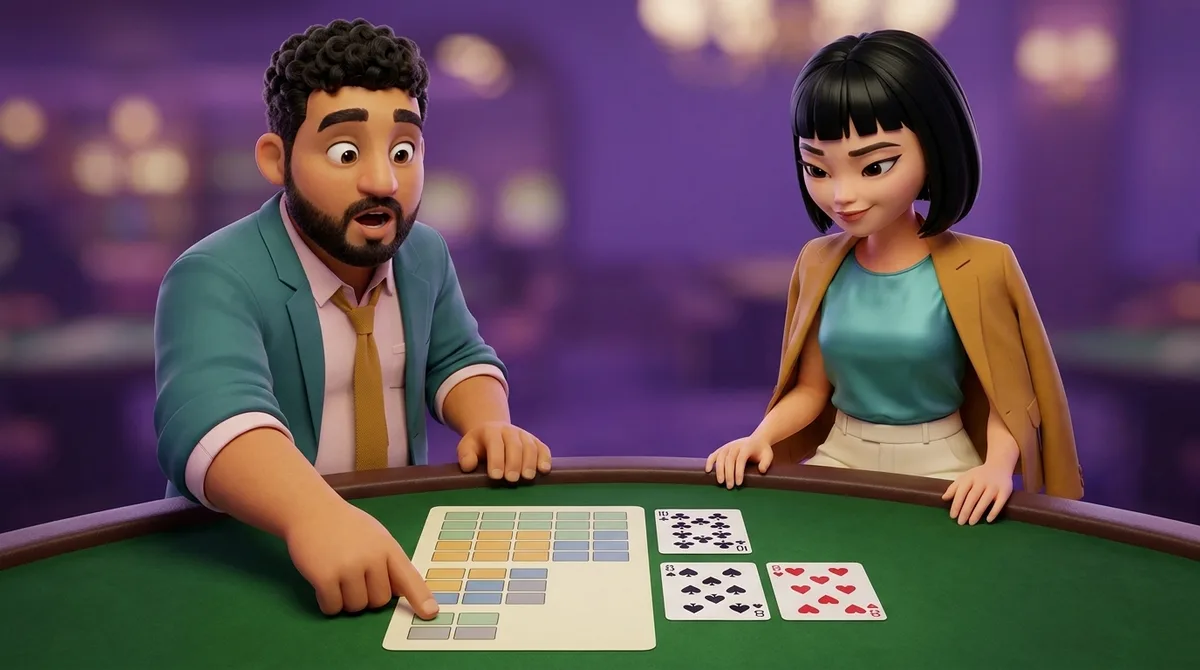
Which of the three tables your cards send you to
A basic strategy chart looks like one big page of letters, and it is three tables stacked on that page. Nothing on it can be read until you know which of the three you are in, and what picks the table is not the total of your hand. It is what your two cards are.
- Two cards of equal valueA pair, and the pairs table answers it. Two eights, two nines, two aces, or a king beside a ten: what matters is that the two cards are worth the same, not what they add up to.
- An ace that can still count elevenA soft hand, and the soft hands table answers it. An ace and a five is a 6 or a 16, and one card cannot take it over 21.
- Everything elseA hard total, and the hard totals table answers it: no ace at all, or an ace that has to count one.
Each of the three tests above is a test on the cards themselves, not on the number they add up to. That is why a count of sixteen can send you to any of the three tables, depending on which two cards made it.
A pair has a table of its own because it has a move of its own: a second bet, and the two cards played as two hands. That second bet can lose exactly as the first can. The pairs table is read only on the first two cards.
An ace is the other card that changes which table you are in, because an ace counts as one or as eleven, whichever suits the hand. While it can still count eleven without taking the hand past 21, the hand is soft, and the soft hands table answers it. The moment a card would take it past 21, the ace counts one, and the same hand moves to the hard totals table.

Leoformer dealer · rules and maths
Table, then row, then column, in that order every time. The first of those three steps is the one people skip: they see sixteen, walk straight to the hard totals table, and never notice that the sixteen in front of them is a pair of eights or an ace and a five. If you make yourself name the hand out loud before you look anything up, you will not skip it.
The whole chart, printed here
Here are all three tables for the national rules of France: hard totals first, then soft hands, then pairs. Together they hold 280 cells, and a hand in front of you needs exactly one of them.
| Hard | 2 | 3 | 4 | 5 | 6 | 7 | 8 | 9 | 10 | A |
|---|---|---|---|---|---|---|---|---|---|---|
| 5–8 | H | H | H | H | H | H | H | H | H | H |
| 9 | H | Dh | Dh | Dh | Dh | H | H | H | H | H |
| 10 | Dh | Dh | Dh | Dh | Dh | Dh | Dh | Dh | H | H |
| 11 | Dh | Dh | Dh | Dh | Dh | Dh | Dh | Dh | H | H |
| 12 | H | H | S | S | S | H | H | H | H | H |
| 13 | S | S | S | S | S | H | H | H | H | H |
| 14 | S | S | S | S | S | H | H | H | H | H |
| 15 | S | S | S | S | S | H | H | H | H | H |
| 16 | S | S | S | S | S | H | H | H | H | H |
| 17+ | S | S | S | S | S | S | S | S | S | S |
| Soft | 2 | 3 | 4 | 5 | 6 | 7 | 8 | 9 | 10 | A |
|---|---|---|---|---|---|---|---|---|---|---|
| A,2 | H | H | H | Dh | Dh | H | H | H | H | H |
| A,3 | H | H | H | Dh | Dh | H | H | H | H | H |
| A,4 | H | H | Dh | Dh | Dh | H | H | H | H | H |
| A,5 | H | H | Dh | Dh | Dh | H | H | H | H | H |
| A,6 | H | Dh | Dh | Dh | Dh | H | H | H | H | H |
| A,7 | S | Ds | Ds | Ds | Ds | S | S | H | H | H |
| A,8 | S | S | S | S | S | S | S | S | S | S |
| A,9 | S | S | S | S | S | S | S | S | S | S |
| Pair | 2 | 3 | 4 | 5 | 6 | 7 | 8 | 9 | 10 | A |
|---|---|---|---|---|---|---|---|---|---|---|
| 2,2 | P | P | P | P | P | P | H | H | H | H |
| 3,3 | P | P | P | P | P | P | H | H | H | H |
| 4,4 | H | H | H | P | P | H | H | H | H | H |
| 5,5 | Dh | Dh | Dh | Dh | Dh | Dh | Dh | Dh | H | H |
| 6,6 | P | P | P | P | P | H | H | H | H | H |
| 7,7 | P | P | P | P | P | P | H | H | H | H |
| 8,8 | P | P | P | P | P | P | P | P | H | H |
| 9,9 | P | P | P | P | P | S | P | P | S | S |
| 10,10 | S | S | S | S | S | S | S | S | S | S |
| A,A | P | P | P | P | P | P | P | P | P | H |
A single letter is a single move. Two letters name two: the move the chart wants, then what to do if it is not available. A double is allowed on any first two cards, whatever they add up to, and it buys exactly one card, so the soft hands table doubles too, and a hand of three cards takes the second letter. Nothing on this chart gives up half the bet: surrender is not one of the national rules. A casino may allow it in its house rules, for half the bet, on your first two cards and never against an ace; this chart leaves it out.
- HTake another card.
- STake no more cards.
- DhDouble your bet and take one card. If the table will not let you double this hand, take a card instead.
- DsDouble your bet and take one card. If the table will not let you double this hand, take no more cards.
- PPut a second bet down and play the two cards as two hands.
Finding the one cell you need
- Name the hand. A pair of equal value, a hand with an ace that can still count eleven, or a total. That names the table.
- Run down the left-hand side until you reach your own hand, and stop on that row.
- Run along that row to the column headed by the dealer’s card, and read the letter where the row and the column meet.
A row read without its column gives a wrong answer out of a right table. A hand has no play of its own; it only has a play against the card the dealer is showing.
| Pair | 2 | 3 | 4 | 5 | 6 | 7 | 8 | 9 | 10 | A |
|---|---|---|---|---|---|---|---|---|---|---|
| 8,8 | P | P | P | P | P | P | P | P | H | H |
Nine of the ten cells in the row belong to other dealer cards. The same pair of eights against a 10 reads H, take a card, and so does it against an ace: the dealer’s second card is dealt only after you play, and the rulebook does not say whether a blackjack made with it takes the second bet too. The chart assumes that it does.
What a cell settles, and what it does not
The letter in a cell is the play that comes out ahead on average over every hand of that one pairing — your hand against that dealer card. It is not a reading of the two cards lying in front of you, and it cannot be: the chart was worked out before those cards were dealt and knows nothing about them.
Played by every row of all three tables, these rules still leave the house 0.51% of every bet on average. The house keeps its edge; the chart only makes it smaller. What following the chart does is reduce the house advantage and the cost of playing; what it cannot do is settle how a hand, or an evening, comes out.
| Your two cards, and the dealer’s card | What that hand’s own table says | Read as a different hand instead | Costs each time |
|---|---|---|---|
| Eight and eight against a 6 | Split the pair | Read as a hard sixteen, and take no more cards | 5.66 units |
| Ace and five against a 6 | Double the bet and take one card | Read as a hard sixteen, and take no more cards | 3.32 units |
| Nine and nine against an 8 | Split the pair | Read as a hard eighteen, and take no more cards | 1.32 units |
Each row above is one hand read in the wrong table, and the last column is the difference between the two plays, averaged over many hands of that pairing, for an example bet of 10 units — an example, not a suggested bet. The price is not the same in every row, and that is where to spend your attention: the three tables are not equally forgiving.
The card you carry to the table
None of this has to be carried in your head. The card further down this page holds all three tables and is made to be printed; keep it open on your phone instead if that is easier. The rulebook says nothing about a printed card at the table, either way: ask before you put one on the felt. What it does say is that a player who bets on your hand from behind you, with your agreement, may not give you instructions or advice, and goes along with what you decide.

Mayaformer floor supervisor · manners, money and breaks
Decide how much money the evening gets and how long it runs before you sit down, and stop when either one is used up. A run of losing hands is not a debt the table owes you, and playing every cell of the chart correctly does not make the next hand owe you anything either: putting more money down to get it back only makes the hour dearer. If the money on the table starts to feel like money you need, stop and call one of the lines below.
If it stops being fun
If gambling stops being fun, the ANJ voluntary gambling ban applies in every casino in France. Minimum entry age: 18. Minors, even emancipated ones, may not enter a casino; ID is checked at the entrance to the gaming rooms. More on responsible gaming.
Show all regions
The lesson on one card
That is the lesson. Here it is on one card, with all three tables on it: print the card, or keep it on your phone.
| Hard | 2 | 3 | 4 | 5 | 6 | 7 | 8 | 9 | 10 | A |
|---|---|---|---|---|---|---|---|---|---|---|
| 5–8 | H | H | H | H | H | H | H | H | H | H |
| 9 | H | Dh | Dh | Dh | Dh | H | H | H | H | H |
| 10 | Dh | Dh | Dh | Dh | Dh | Dh | Dh | Dh | H | H |
| 11 | Dh | Dh | Dh | Dh | Dh | Dh | Dh | Dh | H | H |
| 12 | H | H | S | S | S | H | H | H | H | H |
| 13 | S | S | S | S | S | H | H | H | H | H |
| 14 | S | S | S | S | S | H | H | H | H | H |
| 15 | S | S | S | S | S | H | H | H | H | H |
| 16 | S | S | S | S | S | H | H | H | H | H |
| 17+ | S | S | S | S | S | S | S | S | S | S |
| Soft | 2 | 3 | 4 | 5 | 6 | 7 | 8 | 9 | 10 | A |
|---|---|---|---|---|---|---|---|---|---|---|
| A,2 | H | H | H | Dh | Dh | H | H | H | H | H |
| A,3 | H | H | H | Dh | Dh | H | H | H | H | H |
| A,4 | H | H | Dh | Dh | Dh | H | H | H | H | H |
| A,5 | H | H | Dh | Dh | Dh | H | H | H | H | H |
| A,6 | H | Dh | Dh | Dh | Dh | H | H | H | H | H |
| A,7 | S | Ds | Ds | Ds | Ds | S | S | H | H | H |
| A,8 | S | S | S | S | S | S | S | S | S | S |
| A,9 | S | S | S | S | S | S | S | S | S | S |
| Pair | 2 | 3 | 4 | 5 | 6 | 7 | 8 | 9 | 10 | A |
|---|---|---|---|---|---|---|---|---|---|---|
| 2,2 | P | P | P | P | P | P | H | H | H | H |
| 3,3 | P | P | P | P | P | P | H | H | H | H |
| 4,4 | H | H | H | P | P | H | H | H | H | H |
| 5,5 | Dh | Dh | Dh | Dh | Dh | Dh | Dh | Dh | H | H |
| 6,6 | P | P | P | P | P | H | H | H | H | H |
| 7,7 | P | P | P | P | P | P | H | H | H | H |
| 8,8 | P | P | P | P | P | P | P | P | H | H |
| 9,9 | P | P | P | P | P | S | P | P | S | S |
| 10,10 | S | S | S | S | S | S | S | S | S | S |
| A,A | P | P | P | P | P | P | P | P | P | H |
- Hhit
- Sstand
- Dhdouble (if not allowed, hit)
- Dsdouble (if not allowed, stand)
- Psplit
Six decks, the dealer stops on every 17, a double on any first two cards, no surrender unless the casino’s house rules allow it.
18+ across France · Set a limit before you sit · Play responsibly · helplines: the help box on this page
Check yourself

Mayaformer floor supervisor · manners, money and breaks
Five quick ones. Pick an answer, then check it. No timer, no points: just whether it stuck.
And the question this lesson started with: an eight and an eight against a 6 is a pair before it is a sixteen, so the pairs table answers it, and the cell says P — put a second bet down and play the two cards as two hands.
Where to go next
How it’s worked out
Rules, numbers and hosts
Where this happens. Every blackjack table on this page is a table you can walk up to in a room. The three tables of the chart are worked out for the national rules of blackjack in every casino in France: six decks, the dealer stopping on every 17, an ace counted as eleven whenever that makes 17 or more, a double on any first two cards and after a split, a pair split again when a new pair comes, one pair of aces with one card on each split ace, and every card dealt face up, with the dealer’s second card dealt after the players. A casino may set options of its own in its house rules — surrender, no card on 21, limits on splitting, no double after a split; the chart leaves them out. What a dealer blackjack takes from a double or a split the rulebook does not say; the chart assumes it takes every bet on the hand. It is a preset for learning, not a statement about any one casino.
Numbers. Every figure on this page is worked out when the page is built, by our blackjack engine. The cells of all three tables come from one solve of those rules, so the chart here cannot drift away from the chart in the lessons that teach its rows one at a time. The share of a bet the house keeps assumes the whole chart and cards shuffled after every hand. The count of cells is the count of the rows printed above, not of every total the engine works out: in the hard totals table the lowest totals share one printed row, and so do the highest, where they play the same way all the way across, and the label on the left of each row names the totals that row covers. The price of reading the wrong table is the average result of the hand’s own play minus the average result of the other play, per hand, shown for the example bet, each average rounded to the hundredth first.
No practice table. The blackjack practice table used across this track does not carry these rules, so this page has none.
What is deliberately absent. There is no count of cards, no betting system and no figure for how long money lasts at a table, and no claim about what any one casino allows you to have in your hands at the table.
Hosts. Leo and Maya are illustrated characters. Their backstories, a former dealer and a former floor supervisor, are written for the course: neither is a real person, and neither speaks for any casino. The rules and numbers on this page come from the sources it cites, not from their experience.
No promise. Blackjack is played against the house. The chart lowers the price of playing; nothing on this page makes the game free of cost, and nothing on it says how an evening will end.
When a pair may be split
Lorsqu'un joueur reçoit, aux deux premiers coups, deux cartes de même valeur, il peut considérer qu'il a deux mains séparées.Free translation: When a player receives, on the first two draws, two cards of the same value, he may consider that he has two separate hands.
Si pour l'une de ces mains il obtient lors de la première distribution une deuxième carte formant une nouvelle paire, il peut à nouveau la séparer et déposer une autre mise égale.Free translation: If for one of these hands he obtains, in the first deal, a second card forming a new pair, he may split it again and place another equal bet.
Section Art. 35 (affichage), 55-4 (fonctionnement du black-jack), 55-5 (maxima et minima)
Légifrance · Arrêté du 14 mai 2007 relatif à la réglementation des jeux dans les casinos · read
Si pour l'une de ces mains il obtient lors de la première distribution une deuxième carte formant une nouvelle paire, il peut à nouveau la séparer et déposer une autre mise égale.Free translation: If for one of these hands he obtains, in the first deal, a second card forming a new pair, he may split it again and place another equal bet.
Section Art. 55-4, 3° Les paires
What an ace is worth
Les As équivalent à 1 ou à 11 selon le jeu du joueurFree translation: Aces are worth 1 or 11 depending on the player's hand
Lorsqu'il a un as parmi ses cartes, il doit le compter pour 11 points si avec cette valeur il atteint 17 ou plus.Free translation: When he has an ace among his cards, he must count it as 11 points if with this value he reaches 17 or more.
Section Art. 35 (affichage), 55-4 (fonctionnement du black-jack), 55-5 (maxima et minima)
Légifrance · Arrêté du 14 mai 2007 relatif à la réglementation des jeux dans les casinos · read
Doubling in France
Quel que soit le nombre de points obtenu avec ses deux premières cartes, il peut doubler sa mise. Dans ce cas, il n'a droit qu'à une seule carte supplémentaire.Free translation: Whatever the number of points obtained with his first two cards, he may double his bet. In this case, he is entitled to only one additional card.
Section Art. 55-4, 4° La double mise
Dans ce cas, il n'a droit qu'à une seule carte supplémentaire.Free translation: In this case, he is entitled to only one additional card.
Section Art. 35 (affichage), 55-4 (fonctionnement du black-jack), 55-5 (maxima et minima)
Légifrance · Arrêté du 14 mai 2007 relatif à la réglementation des jeux dans les casinos · read
Surrender in France
La direction du casino peut, dans son règlement intérieur :Free translation: The casino management may, in its house rules:
autoriser un joueur à abandonner la partie, après distribution de ses deux premières cartes et sous réserve que le croupier n'ait pas d'as, ce qui entraînera la perte de la moitié de sa miseFree translation: allow a player to give up the hand, after his first two cards have been dealt and provided that the dealer does not have an ace, which will result in the loss of half of his bet
Section Art. 35 (affichage), 55-4 (fonctionnement du black-jack), 55-5 (maxima et minima)
Légifrance · Arrêté du 14 mai 2007 relatif à la réglementation des jeux dans les casinos · read
The deal in France
A l'issue de ce tour, il se donne une carte, puis distribue une seconde carte, toujours dans le même ordre, à chaque main.Free translation: At the end of this round, he deals himself a card, then deals a second card, always in the same order, to each hand.
Les cartes sont, dans tous les cas, distribuées figure en dessus.Free translation: The cards are, in all cases, dealt face up.
Lorsque tous les joueurs ont déterminé la situation de leurs mains, le croupier tire une ou plusieurs cartes pour lui-même.Free translation: When all the players have determined the status of their hands, the dealer draws one or more cards for himself.
Section Art. 55-4, 1° Jeu simple et black-jack
Who decides the hand
Des joueurs debout peuvent miser sur la main d'un joueur assis avec l'accord de celui-ci et dans les limites du maximum de mise autorisé pour la main, ils ne peuvent toutefois lui donner des instructions ou des conseils et subissent ses initiatives.Free translation: Standing players may bet on the hand of a seated player with that player's agreement and within the maximum bet allowed for the hand; they may not, however, give him instructions or advice, and they are subject to his decisions.
Section Art. 35 (affichage), 55-4 (fonctionnement du black-jack), 55-5 (maxima et minima)
Légifrance · Arrêté du 14 mai 2007 relatif à la réglementation des jeux dans les casinos · read
What a casino may set in its house rules
La direction du casino peut, dans son règlement intérieur :Free translation: The casino management may, in its house rules:
autoriser un joueur à abandonner la partie, après distribution de ses deux premières cartes et sous réserve que le croupier n'ait pas d'as, ce qui entraînera la perte de la moitié de sa miseFree translation: allow a player to give up the hand, after his first two cards have been dealt and provided that the dealer does not have an ace, which will result in the loss of half of his bet
interdire à tout joueur de tirer une nouvelle carte à 21Free translation: prohibit any player from drawing another card on 21
La direction du casino a la possibilité, dans son règlement intérieur affiché, de limiter les paires aux cartes similaires, excluant ainsi les cartes différentes mais de valeur identique. Elle peut également limiter le nombre des paires que peut constituer un même joueur.Free translation: The casino management may, in its posted house rules, limit pairs to similar cards, thereby excluding different cards of identical value. It may also limit the number of pairs that a single player can form.
Toutefois, la direction du casino peut, dans son règlement intérieur, en exclure la possibilité en ce qui concerne les paires.Free translation: However, the casino management may, in its house rules, exclude this possibility as regards pairs.
Section Art. 35 (affichage), 55-4 (fonctionnement du black-jack), 55-5 (maxima et minima)
Légifrance · Arrêté du 14 mai 2007 relatif à la réglementation des jeux dans les casinos · read